TNPA Port of Ngqura: The green port making green energy possible

TNPA Port of Ngqura: The green port making green energy possible

As the only port with a green status in the Southern African port system, Transnet National Ports Authority’s (TNPA) Port of Ngqura has now established itself as the ideal partner in bringing green energy to our nation. It has provided a safe gateway, temporary storage and an accessible distribution point for wind turbine components imported from Spain since 2012.

These components – consisting of wind turbine tower parts, blades, etc. – are destined for various windfarm projects throughout the country. They include the Golden Valley Wind Farm, the Nxuba Wind Farm between Bedford and Cookhouse in the Eastern Cape and the Roggeveld Wind Farm in the Karoo, spanning both the Northern Cape and Western Cape. The majority of wind farms are located across the Eastern Cape. The port has been a major player since the Department of Energy has approved these projects as part of the Independent Power Producer (IPP) process in 2012.

Unique offering

“The port is uniquely positioned to accommodate these special projects cargo or abnormal cargo, classified as General Cargo, at its “Finger Jetty.” It also has a dedicated laydown area of 80 000 m² to store these massive components. The port’s ideal location and accessibility to the national freeway, makes road-haulage of the components to its destination easier, compared to city-locked port. The surrounding infrastructure linking the port to the hinterland is also ideal – no restrictive bridges and the road can handle the abnormal cargo size and weight,” said Nozipho Booi, New Business Development Manager: Port of Ngqura.

Additional revenue stream

“The almost 50 000 million tons of wind turbine cargo that was imported in the 2019/20 financial year, fit perfectly into the port’s revenue diversification strategy of avoiding over-reliance on a single revenue stream,” said Tandi Lebakeng, Port Manager of the Port of Ngqura.

What is a green port?

A green port status means that it is a port that was subjected to environmental legislation during its entire development – from pre-construction, during its current operation and will be during its future development.

Wind turbine tower components (top) and blades (bottom) stored in the Port of Ngqura before being transported by road and assembled at various wind farms throughout the country.

VWSA resumes production and exports

VWSA resumes production and exports

  • Uitenhage plant restarts production in line with Level 4 lockdown regulations
  • 100-point plan implemented to protect employees on site

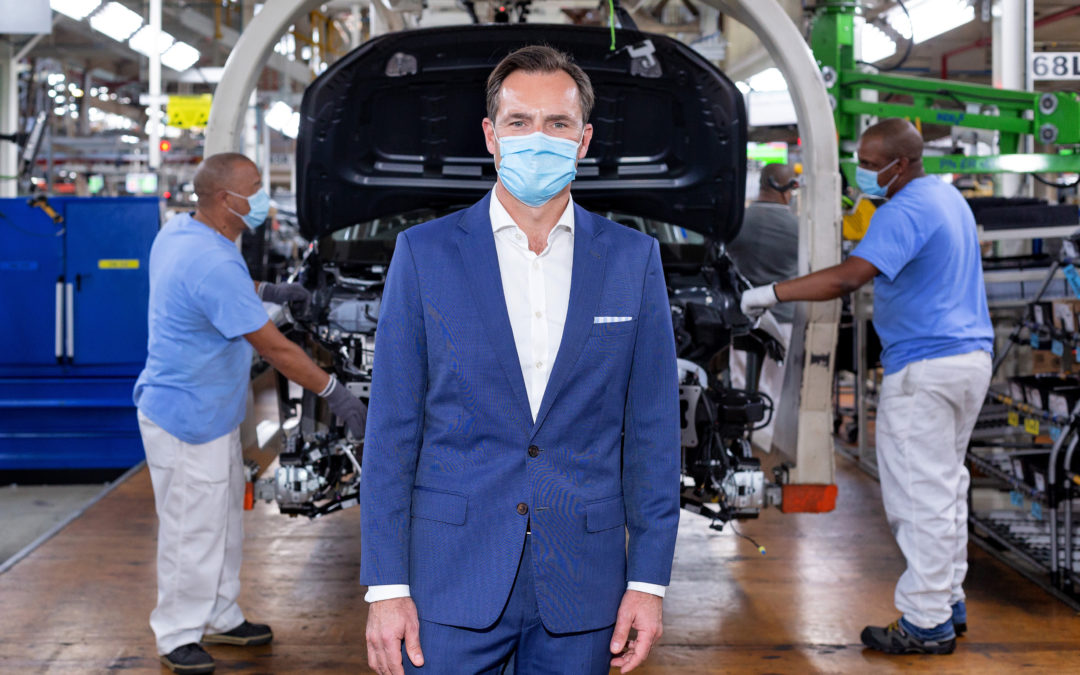
Uitenhage – Following a gradual ramp-up of its local production, the Volkswagen Group South Africa (VWSA) plant in Uitenhage has resumed its manufacturing operations.

In line with the regulations pertaining to Level 4 of lockdown, VWSA production was restarted on 4 May, with essential employees returning to work in a phased approach. The company has since started exporting Polos to various markets, in addition to manufacturing Polos and Vivos for the local market. On-site employees are supported by colleagues who continue to work from home where this is possible.

Prior to the gradual ramp-up of production, a number of measures to combat Covid-19 were put in place at all VWSA sites. These measures form part of a 100-point plan implemented across the Volkswagen Group to ensure the health and safety of employees. The plant’s on-site Wellness Centre has been equipped and its staff continues to consult with high-risk employees to ensure their wellbeing is prioritised.

Upon their return to work, employees were informed of the new protocols through employee orientation sessions, a detailed booklet and extensive signage installed at all sites and areas. Returning employees were further informed regarding hygiene and physical distancing practices that can further protect them. The company also provided each employee with a set of masks and over 20 tons of hand sanitiser have been sourced for all VWSA sites.

“Our essential services team ensured that the workplace was Covid-19 compliant before we officially restarted production in Uitenhage,” said Jens Bruecker, Production Director at VWSA. “Our 100-point plan is designed to ensure that all employees feel safe and good about their workplace, so we can manufacture and deliver vehicles without compromising our commitment to the wellbeing of our employees.”

“With dealerships being allowed to reopen on a phased basis, VWSA will again be able to meet the needs of its loyal local customer base,” said Mike Glendinning, VWSA’s Sales and Marketing Director. “Our team has worked remotely during the lockdown to support dealerships in preparing to reopen, and to assist customers through our Customer Interaction Centre. In addition, VW Commercial Vehicle dealerships remained open over the lockdown period to service vehicles for essential services. We look forward to welcoming our customers back to the dealerships, and we are taking every precaution to prepare for this.”

VWSA’s Chairman and Managing Director, Thomas Schaefer, thanked Naamsa for its assistance in lobbying with government for the automotive industry to be allowed to reopen. “The automotive industry has a crucial role to play in the local and national economy,” said Schaefer. “We are grateful that this role was acknowledged with the decision to let the industry operate and trade again.”

“In many aspects, the Covid-19 crisis has eclipsed our daily lives. As such, it must be our main priority at VWSA to act responsibly in every aspect of our business – and this includes, first and foremost, to ensure that our employees can work without risking their health. We will continue our extensive efforts to fulfil this duty,” Schaefer concluded.


For more information contact:


Andile Dlamini

Head: Group Communications

Volkswagen Group South Africa

Mobile: +27 82 451 5415

Work:    +27 41 994 5042

E-mail:  andile.dlamini@vwsa.co.za


Automotive Industry Exports Excel in 2019 pre-Covid-19

Automotive Industry Exports Excel in 2019 pre-Covid-19

The 2020 Automotive Export Manual publication just released by Dr. Norman Lamprecht, Executive Manager of the National Association of Automobile Manufacturers of South Africa (NAAMSA) and the Automotive Industry Export Council (AIEC) highlights that the export value of vehicles and automotive components comprised a record R201,7 billion, equating to 15,5% of South Africa’s total exports in 2019. A record 387 125 vehicles worth a record R148,0 billion, along with a record R53,7 billion in automotive components, were exported to 151 countries in 2019. From 2018 to 2019, the total export values more than doubled in the case of 19 countries.

South Africa’s global vehicle production ranking remained at 22nd in 2019, although its market share improved from 0,64% to 0,69% due to the record 631 983 vehicles produced in 2019, supported by the industry’s record vehicle export performance. South Africa remained the dominant market on the African continent and accounted for 57,2% of total African vehicle production of 1,12 million vehicles.

South Africa is highly exposed to economic conditions in China and the world economy in general, and the Covid-19 pandemic will stifle export-oriented industries and manufacturing in the foreseeable future. South African exporting companies will be required to consider various scenarios for the world economy and global trade patterns in the short to medium term according to Dr. Lamprecht.

The automotive industry across the world is currently experiencing unprecedented challenges due to the global lockdowns implemented across all major automotive manufacturing countries to flatten the Covid-19 curve, and South Africa is no exception to this. However, since the grand vision of the automotive industry involves electric vehicles, connected cars and autonomous driving, the latter two could just be accelerated as a result.

Download below the full media release from NAAMSA highlighting the 2019 key statistics as well as the 2020 Automotive Export Manual.