High rewards and risks in Eastern Cape citrus industry

High rewards and risks in Eastern Cape citrus industry

On the back of the highest ever recorded exports of over 3 tons of citrus out of South Africa in 2025, key role players in the local citrus industry were cautiously optimistic about the 2026 season.

South Africa became the largest exporter of citrus in the world with 203.9-million 15 kg cartons of citrus exported in 2025, having been the largest exporter of citrus in the Southern hemisphere for some time.

The landmark season for the industry was celebrated during today’s [24 June] Citrus Panel discussion hosted by Exporters Eastern Cape in partnership with Standard Bank in Gqeberha.

Standard Bank Executive Head: Commercial Agri Business Bertie Hamman, a panelist at the event, said the citrus industry had a good run over the last 12 months.

“Our story is probably one of the best success stories in agriculture in South Arica. I am really proud to say we are the largest exporter of citrus in the world – it didn’t happen by chance. This was because of the concerted efforts by the industry and Citrus Growers Association (CGA) to be deliberate in developing and diversifying markets, making investments into orchards, packhouses and the logistics value chain and the diplomacy by industry leaders should also be commended,” said Hamman.

CGA CEO Dr Boitshoko Ntshabele said the industry remains committed to the long-term CGA Vision of exporting 260-million cartons by 2032.

While Ntshabele admitted that it was an interesting current season with the war and interest rate fluctuations, he believes quality will be a main differentiator the 2026 season.

“Climate change is another reality, and the question is what are we adding to the toolbox of growers to build their resilience and develop new instruments to help against floods and hail,” said Ntshabele.

Eastern Cape outlook

With the Eastern Cape being a key region for the industry, which across the country employs 140 000 people at farm level, Sundays River Citrus Company (SRCC) CEO Hannes de Waal said risks will always come with unpredicted times.

“Recent floods going over the 100-year mark is a new phenomenon beyond our expectations, even though we watch the weather like hawks. Storms are affecting the industry world-wide; we are in agriculture after all… but the droughts appear more intense. It is a tough challenge for industry, but SA is still very well positioned compared to other competitors. Our farmers are resilient – this season we compete against ourselves and profitability depends on how we optimize and collaborate,” said De Waal.

CGA Logistics Development Manager Mitchell Brooke said the citrus industry was “riding a wonderful wave at the moment” following the successful 2025 season but said that the last 10 years had not been without its challenges in the export context.

“The Eastern Cape is a fascinating citrus growers’ region: production is relatively close to the ports compared to other regions, the road networks are being rehabilitated, like at the Sundays River Valley, the region has a dual port system with capacity and availability and many cold storage areas,” said Brooke.

While there are some risks, he said the industry still has a lot of growth opportunities and investment solutions. One of these he recommended was sustainable energy alternatives since the citrus industry was a high energy-intensive sector.

Exporters Eastern Cape Chairman Quintin Levey thanked the panelists for their participation in the lively discussion. He said the citrus industry success in the region can be attributed to continued, strong collaboration.

“At Exporters EC we regularly participate in these collaborations, whether it be meetings with Transnet, our regular task-team meetings or showcasing the citrus exporters’ important work through our various platforms,” said Levey.

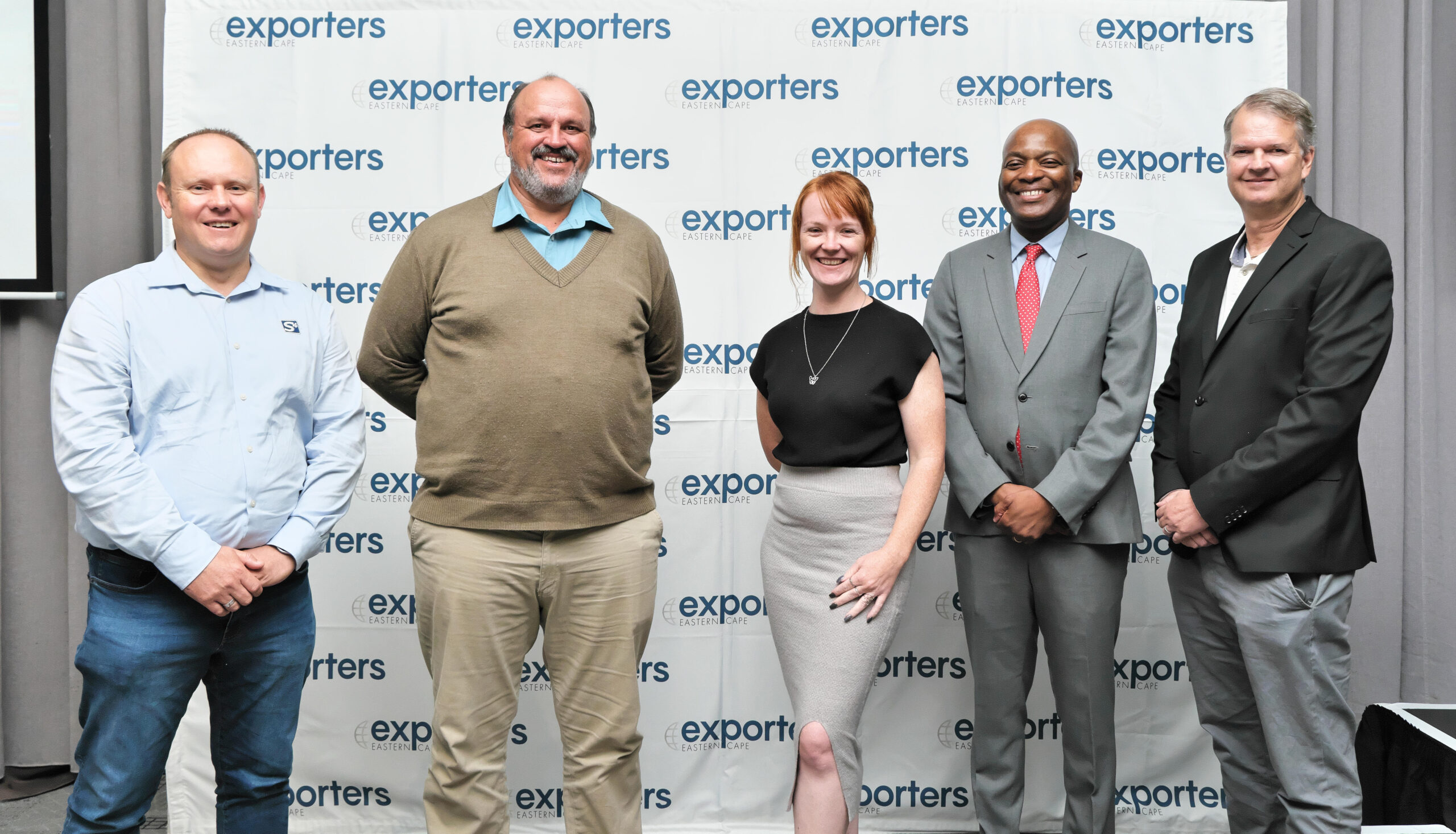
Caption for image: Pictured after the Citrus Panel Discussion were from left Kobie Venter (Standard Bank), Alan Barr (KPMG), Samantha Dunlop (Exporters EC), Bertie Hamman (Standard Bank) and Quintin Levey (Exporters EC).

Let’s Talk Exports – CSI should be practised all-year round

Let’s Talk Exports – CSI should be practised all-year round

Building strong relationships with community stakeholders is an important aspect of good business practice.

While it is not the core business of organisations today to develop sustainable partnerships in the communities where they operate, it is the ethical responsibility of corporates to respond to local stakeholders, since no company operates within a vacuum.

As the economy gets more unpredictable in the Eastern Cape with local and global challenges, CSI may be the last thing on the mind of a busy corporate organisation. We may even run the risk of treating CSI as a box-tick exercise, perhaps something embarked upon reluctantly once a year because it is “the right thing to do”.

When disasters like the recent devastating floods in the Eastern and Western Cape hit, companies are not immune and may be impacted by these adverse conditions from a logistical and production perspective. When staff members’ homes are flooded, this is when the caring corporate citizen can make a real difference in the lives of their employees and local communities.

In Nelson Mandela Bay, many exporters are responsive not only to local disaster relief efforts, they also meaningfully invest in long-term projects and partnerships that bring about real change in the communities where their employees live. Building partnerships – sometimes even with competitors in the market place – for the greater good of the community brings about more impactful change than what one individual organisation can achieve on its own.

Last year, Exporters Eastern Cape introduced two new categories at the prestigious Exporter of the Year Awards, which for the first time acknowledged exporters for their CSI initiatives in the Eastern Cape.

The Community Chest CSI Award (Small & Medium Companies) is a category for exporters and service providers who have spent up to R1-million on CSI initiatives in one financial year. The Community Chest CSI Award (Large companies) is a category for exporters and service providers who have spent over R1-million on CSI initiatives in one financial year.

In 2025, the former was won by DG Incentives while the latter, the category for large companies, was won by Volkswagen Group Africa and a Merit Award was awarded in the same category to Isuzu Motors South Africa. From building schools to nutrition centres, these exporters understand the true value of practicing CSI – all year round – through long-term partnerships with community stakeholders in the local communities of Nelson Mandela Bay.

Sustained commitment to social development in challenging economic conditions are more important now than ever before.

We invite more corporates to lead by example and enter their CSI projects in the Exporters Eastern Cape Exporter of the Year Awards. It is our sincere hope that exporters continue investing in sustainable CSI initiatives in the region, and that the awards inspire others to do good and bring about a positive change in the Eastern Cape.

If you would like to partner with Exporters Eastern Cape, DG Capital and Community Chest of the Eastern Cape this Mandela Day, please connect with colettep@cchestpe.org.za.

By Quintin Levey, Exporters Eastern Cape Chairman

Published in The Herald, May 2026

Let’s Talk Exports – CSI should be practised all-year round

Let’s Talk Exports – Citrus farming: A lifeline for the Eastern Cape

The citrus industry plays a very important role in the Eastern Cape. When people talk about agriculture in the province, citrus farming is often one of the first things that comes to mind. From oranges and lemons to soft citrus like naartjies and mandarins, this industry has become a key driver of economic activity and employment in the region.

In fact, the Eastern Cape is the second-largest citrus producing province in South Africa and contributes around 27% of the country’s total citrus production. Large citrus-growing areas such as the Sundays River Valley, Patensie, and the Kat River Valley play a major role in this production. These regions have ideal climates for citrus farming, which allows farmers to produce high-quality fruit that can compete in international markets. The Eastern Cape is also responsible for about 60% of South Africa’s lemons, 30% of soft citrus and 26% of exported oranges, showing how significant the province is to the national industry. 

However, for many communities, especially in rural areas, citrus farming is not just about producing fruit. It is about creating opportunities and supporting livelihoods. Citrus farming requires many workers for planting, maintaining orchards, harvesting fruit and packaging it for export. To quote Mitchell Brooke of the Citrus Growers’ Association of South Africa: “The Eastern Cape accounts for a quarter of SA’s citrus exports. Over 25 000 hectares of citrus are under cultivation. This provides approximately 35 000 jobs in the Eastern Cape on farm-level alone – not including the down-chain employment in logistics and other sectors.”

The citrus industry also contributes to South Africa’s global trade. South Africa is currently the second-largest exporter of citrus fruit in the world, and citrus exports have grown significantly in the past decade. “South African citrus is well-known in international markets for its quality and taste,” Mitchell shares. “As a source of foreign income, the entire South African citrus industry brings in about R42 billion in foreign revenue each year.”

However, the industry also faces several challenges, from water shortages and rising production costs to global trade barriers and logistics. “We need improved market access, whether through tariff reductions in certain markets or through improved scientific plant health; and we need greater urgency and scale on private sector participation in logistics. Our input costs are also likely to increase, which places pressure on agricultural producers.”

Exporters Eastern Cape has played a pivotal role in strengthening the Eastern Cape’s citrus industry. Our Strategic Manager Samantha Dunlop shares: “Through initiatives such as coordinated planning sessions, data-sharing frameworks, and industry workshops, Exporters EC helps improve visibility on volumes, equipment availability, and port readiness—critical factors during peak citrus season. The province is further supported by world-class infrastructure, including modern port facilities, efficient road networks, and specialised cold chain capacity, enabling citrus to move swiftly from orchard to international markets. The organisation also advocates for improved port performance, increased reefer capacity, and streamlined processes with Transnet, ensuring that exporters can move perishable cargo efficiently to global markets.”

The citrus industry is more than just a farming activity in the Eastern Cape. It is a foundation for economic development in the region. It creates thousands of jobs, supports rural communities and connects the province to international markets. As long as the industry continues to grow and receive the right support, it will remain a vital part of the Eastern Cape’s future – and we as Exporters Eastern Cape will continue providing that support.

By Quintin Levey, Exporters Eastern Cape Chairman

Exporters Eastern Cape Celebrates Excellence and Opens 2026 Award Entries

Exporters Eastern Cape Celebrates Excellence and Opens 2026 Award Entries

GQEBERHA, SOUTH AFRICA – 01 April 2026 – Exporters Eastern Cape (Exporters EC) recently hosted an exclusive gathering at Wirk to celebrate the achievements of the region’s top trading businesses, headlined by a special tribute to S4 Group, the reigning 2025 Exporter of the Year.

The event brought together key industry players and members of the Exporters EC to reflect on the impact of export growth in the province and to officially launch the search for the 2026 award winners. A highlight of the day was an interactive panel discussion featuring industry leaders who shared valuable perspectives on the awards and the broader economic landscape.

Dr Randall Jonas (Awards Judge) emphasised that entering the awards requires deep company insight. “It is advisable for businesses to ensure that entries are compiled by senior leaders who know the company intimately rather than juniors. A winning entry must be thoughtful, well-structured, and clearly highlight the company’s sustained achievements over the years.”

These yearly awards give companies a chance to evaluate their operational effectiveness, assess their economic impact and strengthen their competitive position. Putting emphasis on the value of gaining recognition, Exporters EC Chairman Quintin Levey said: “these awards provide a critical yardstick to measure how the Eastern Cape is performing against outside competition, while allowing local businesses to gauge their growth against peers.”

Last year’s winner, The S4 Group, is a multi-award winning company offering turnkey automation and industrial software solutions worldwide. Having won the Exporter of the Year award three times in a row, Gideon Smith (Marketing Manager, S4 Integration) said: “Being part of the Exporters EC fosters a vital sense of community. Winning the 2025 Exporter of the Year award was a massive honour for S4 Integration, serving as a testament to the hard work of every single employee in the company.”

Following the panel, Exporters EC officially announced that entries for the 2026 Exporter of the Year Awards are now open.

Entry Deadline: August 7, 2026

Awards Evening: November 6, 2026

Venue: The Tramways Building

Businesses across the Eastern Cape are encouraged to submit their entries early to showcase their contributions to the global market and regional economy. Some of the awards categories include:

  • Best Exporter: Medium Enterprise
  • Best Exporter: Original Equipment Manufacturer
  • Best Exporter: Small Business
  • Emerging Exporter Award
  • IDC Job Creator Award
  • Overall Exporter of the Year winner and more.

The event and the upcoming awards are made possible through the valued support of sponsors, including Kingfisher FM, one of the media sponsors, and Business Coach, Colin Carmody from The Alternative Board, who proudly sponsors the Exporter of the Year Awards.

Media & Entry Contact

For award entries, membership details, or more information about Exporters EC, please contact: Suzanne Loubser at info@exportersec.co.za.

Leaders urged to work together now more than ever

Leaders urged to work together now more than ever

Working together to grow the country and economy is now more important than ever, according to Justice Malala, the political analyst, best-selling author and speaker who addressed Exporters Eastern Cape members at a business event on Friday, March 6 at Radisson Blu Hotel in Gqeberha.

The headline speaker at the Business Breakfast hosted by Exporters Eastern Cape in partnership with BLG Logistics of South Africa, Malala said while resilience was important in the difficult geopolitical climate we find ourselves in, moreover it will be important to collaborate.

He commended organisations like Exporters Eastern Cape and other businesses for working together with government and government entities.

“It shows us what can be achieved if we all work together, there are areas where you see a lot of changes that we should not take in vain with reforms taking place – Eskom is beginning to work …the more incentives, the more factories we can put up and partner to do better and get more work. We can do more to make it easier and attractive for people to come and establish businesses here,” said Malala.

Exporters Eastern Cape Chairman Quintin Levey earlier mentioned to members that the strategic leadership team of Exporters Eastern Cape will be meeting with Transnet later this month to discuss exporter logistics challenges and cement a closer working relationship with Transnet.

“The most important thing we are going to have to do for ourselves and our businesses, is to make sure we are united and use organisations like Exporters Eastern Cape to get things done. Without being organised, we are all finished. If we want to fix the country and all the big issues we face, we all have to work in a way to say let’s work together,” continued Malala.

While the international geopolitical tensions will remain red flags of big concern for South African businesses for some time, Malala said there were also “green shoots” with the Government of National Unity (GNU) that came into power.

“We have succeeded in places where we thought we wouldn’t, three years ago loadshedding was a real crisis but now it is almost like another world and things have changed substantially. In 1994, leadership was what saved the country and we are back at the time where the geopolitics are so sensitive we are going to need leadership to navigate the unknowns…these things will happen, but leadership is the key thing we are going to need in the country.”

He predicted big changes for the local government elections later on this year, and said corruption on all levels needs to be exposed more and more to act as a deterrent.

Shane Gerber, Managing Director of BLG Logistics of South Africa, referred to these positive developments in the local economy as “glimmers of hope” as he opened the business breakfast and introduced Malala.

Exporters Eastern Cape would like to thank event partners, BLG Logistics of South Africa and Radisson Blu Hotel, for the insightful event.


Citrus Logistics & Industry Outlook Shared at CRI Postharvest Technical Forum

Citrus Logistics & Industry Outlook Shared at CRI Postharvest Technical Forum

The Citrus Research International (CRI) hosted its annual Postharvest Technical Forum on 17 & 18 February at Mentorskraal in Jeffreys Bay. The forum brings together packhouse managers, growers, exporters, and logistics professionals to focus on critical post-harvest issues and the evolving needs of the industry.

The CRI is a key scientific body that conducts applied research and facilitates practical workshops to help citrus value-chain stakeholders adopt best practices and respond to industry challenges. The purpose of this forum, part of a series of post-harvest workshops, is to share research, data, trends and solutions that support improved fruit quality, efficient export logistics, and sustainable industry growth. The 2026 workshop series aims to provide practical insights on post-harvest handling, logistics systems, and production forecasts well ahead of the next export seasons.

Economic & Logistics Environment – A Favourable Outlook Despite Some Cost Pressures

One of the core presentations, by Samantha Dunlop, representing the Citrus Growers’ Association and Exporters Eastern Cape, at the forum provided an update on current economic and shipping trends affecting citrus exporters:

  • Transport costs are trending more favourably due to a strengthening rand and declining global fuel prices. This is a positive signal for export freight rates, particularly for ocean freight which is heavily influenced by bunker fuel pricing.
  • However, increasing electricity tariffs remain a concern, as electricity is a major cost driver in cold-storage operations. The approved tariff hikes for the next few years are expected to raise cold-chain costs, underscoring the need for efficiency gains across storage and handling operations.

These insights are critical for exporters planning their cost structures and logistics strategies for upcoming seasons.

Production Growth Forecasts Regional Capacity Planning

A highlight of the forum was the review of long-term crop projection models showing sustained citrus production growth through 2026 and beyond. Key takeaways:

  • Industry models anticipate growth from just over 200 million cartons in 2025 to approximately 260 million cartons in the near term, with continued expansion toward 2030.
  • While annual production may vary due to seasonal or climatic influences, the long-term trend suggests continued expansion in fruit volumes.

The data also emphasised differing regional profiles across the major export corridors:

  • The Eastern Cape, Western Cape, and Northern regions are all projected to grow, with the Eastern Cape expected to add around 20 million cartons over the next few years.
  • Seasonal peaks later in the year, driven by late navels and mandarins, will require careful coordination of cooling, haulage, and export capacity to manage the increased throughput.

Infrastructure Readiness & Logistics Challenges

Forum delegates heard updates on infrastructure readiness across the value chain, including:

  • Cold storage capacity in the Eastern Cape is being strengthened with facility upgrades and new developments, ensuring capacity remains aligned with projected production.
  • Port infrastructure improvements, including increased reefer plug capacity at major terminals, are being prioritised to avoid bottlenecks during peak export weeks.
  • Transport demand, especially for trucking and inland haulage, is expected to grow significantly. With rail services still scaling up, road transport will remain a key component of fruit movement, requiring strategic planning and collaboration across operators.

The Road Ahead: Collaboration & Strategic Planning

Speakers at the forum emphasised the importance of cross-sector coordination. Industry growth presents opportunities, but also demands proactive infrastructure planning, logistics optimisation, and alignment between production forecasts and export capabilities.

The Citrus Growers’ Association of Southern Africa plays a vital role in equipping stakeholders with data-driven insights that support sound decision-making, from cold storage management to pricing strategies and corridor development.

Exporters and production partners are encouraged to engage with CRI’s resources and upcoming workshop series, as well as organisations like the Citrus Growers’ Association of Southern Africa, as the industry prepares for continued growth and evolving market conditions.